

Description
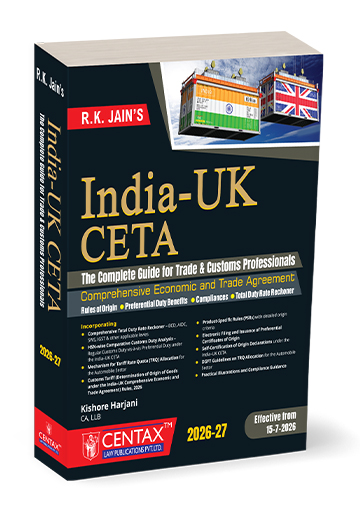
R.K. Jain’s India-UK CETA is the first comprehensive, practice-oriented treatise on the Agreement written for the Indian trade and customs professional. What the book does—and what neither the bare treaty text nor a compilation of notifications can do—is explain, in plain and disciplined language, how the Agreement actually works in practice, in both directions of trade: for the Indian importer claiming preference on goods of United Kingdom origin, and for the Indian exporter establishing Indian origin to the satisfaction of a British buyer and of His Majesty’s Revenue and Customs.
The commentary is built on the treaty text read together with the instruments that carry it into Indian law—the rate notification of 14th July 2026, the CETA Origin Rules, 2026, the CBIC circular implementing self-certification and authentication, the DGFT trade notice on electronic certificates of origin, and the public notices governing the automobile tariff rate quotas—with the law stated as on entry into force and updated till 20th July 2026.
Three qualities distinguish the volume from anything else presently available on the subject.
- Illustration-led Throughout — The book carries forty-seven numbered worked illustrations across eight chapters. Almost every rule is followed by its application to a realistic consignment
- Treats Origin and Duty as One Continuous Question — The book does not stop at the conclusion that goods are originating. In Chapter 9 it takes four goods from the product-specific rules list, confirms the origin position under the applicable rule, and then computes the duty actually saved on importation into India
- Computational Reckoner — Chapter 17’s principal schedule covers all 11,098 tariff lines of the general preferential schedule, HSN by HSN from Chapter 1 to Chapter 97, and for every line states the basic customs duty, AIDC and Health Cess under CETA, the Social Welfare Surcharge under the Customs Tariff Act and the IGST under GST, before computing the total rate with CETA, the total rate without CETA, and the variance in overall duty liability. Distinct schedules follow for alcoholic beverages and for automobiles under the tariff rate quota mechanism. In one glance a professional can see precisely what a preferential claim is worth on any given tariff item
The book is designed as a working desk reference rather than an academic study. It will be of direct and continuing use to:
- Importers Purchasing Goods from the United Kingdom—who must claim preference correctly at the bill-of-entry stage, quote the Unique Reference Number, and substantiate the claim on a verification years later
- Exporters Selling into the United Kingdom—who must establish Indian origin, choose between self-declaration and agency issuance, and generate electronic certificates of origin on the Trade Connect ePlatform
- Customs Brokers, Freight Forwarders and Logistics Service Providers handling India–UK consignments, for whom the procedural chapters are directly operational
- Chartered Accountants, Cost Accountants, Company Secretaries and Advocates advising on customs, foreign trade policy and indirect taxes, who will find the commentary and the reproduced instruments equally serviceable
- In-house Tax, Trade Compliance, Supply Chain, Sourcing and Legal Teams, for whom the book answers the questions their business colleagues actually ask
- Costing Teams, who are unusually well served: the chapters on value addition explain not merely the formulae but how each material is to be valued and which freight, duty and waste adjustments may be added or deducted—the operative question for anyone asked to certify that a good meets its threshold
- Officers of Customs and of the DGFT dealing with preferential claims, origin verification, quota administration and CAROTAR enquiries
- Automobile Manufacturers, Importers and Authorised Dealers navigating the pre-purchase agreement, application window and electronic debit mechanism of the tariff rate quota
- The Spirits and Alcoholic Beverages Trade, for whom the value-based duty regime is commercially decisive
- Exporters in the Textile, Engineering, Chemical, Pharmaceutical, Gems and Jewellery and Auto-Component Sectors, each of which carries distinctive product-specific rules
- Consultants, Trade Economists, Academics and Students of International Trade Law, who will find in it a coherent account of a major agreement in its first year of operation
- Any Business Still Deciding Whether to Source from or Sell into the United Kingdom at all—the comparative reckoner allows a duty-saving assessment to be made at tariff-item level before any commercial commitment is made
The Present Publication is the 1st Edition, updated till 20th July 2026. It is authored by Kishore Harjani, with the following noteworthy features:
- [Complete Coverage of the Agreement] The thirty-chapter treaty is mapped chapter by chapter with the relevant extracts reproduced, so that a reader can locate the discipline governing a particular question and see how the parts of the Agreement fit together—from national treatment and the treatment of customs duties, through services, mobility and investment, to intellectual property, government procurement, innovation, trade and gender equality, and State-to-State dispute settlement
- [A Comprehensive Total Duty Rate Reckoner] Most compilations reproduce the preferential rate of basic customs duty and leave the reader to do the rest. This one maps the Social Welfare Surcharge and IGST at tariff-item level and computes the total landed duty under both scenarios, stating the variance—the number that actually drives a sourcing, pricing or landed-cost decision
- [HSN-wise Comparative Customs Duty Analysis] Regular customs duty is set against preferential duty under the CETA for every line, preceded by a chapter-wise summary which states, for each two-digit HS chapter, the number of tariff lines it contains, the number attaining a nil rate immediately, and the number retaining a positive rate
- [Transparent Methodology] Where the non-preferential basic customs duty is prescribed as the higher of an ad valorem or a specific rate, no meaningful comparison can be drawn; the reckoner leaves those cells blank and footnotes the reason, a note which recurs on some forty pages. Where a tariff line carries two IGST rates, both total rates and both variances are shown. The reader is told what has been computed and what has not
- [Rules of Origin Made Practical] The three criteria of Rule 3, the closed list of wholly obtained goods, the ex-works and free-on-board bases of valuation and why the choice between them can decide a marginal case, both qualifying value content formulae, the valuation of each material, and the roll-up principle are each explained and then illustrated
- [The Complete Product-specific Rules List, Reproduced in Full] Annexure-A, corresponding to Annex 3A of the Agreement and based on the 2022 edition of the Harmonised System, is set out HS-wise across Chapters 1 to 97, with a key to every abbreviation used and a six-step method for applying any rule to any good
- [Focused Treatment of the New Self-certification Regime and the URN] The departure from agency-issued certificates is examined in full, and the authentication framework is explained as a four-step electronic process between HM Revenue & Customs and Indian Customs, supported by twelve dedicated illustrations covering shelf life, warehousing, staggered ex-bond clearances against a single URN, post-facto completion and transitional consignments
- [The Mechanism for Tariff Rate Quota Allocation in the Automobile Sector] The two instruments that make the scheme run—the Finance Ministry rate notification and the DGFT allocation notification—are reconciled against each other, with definitions, a fully worked numerical illustration, the year-on-year duty and quota trajectory, and a candid flag where the two do not align
- [Electronic Filing and Issuance of Preferential Certificates of Origin] The Trade Connect ePlatform workflow is set out on both bases of issuance, including the digital signature requirement, the QR-coded copies and the facility by which an authority may verify a certificate’s genuineness
- [Compliance, Verification and Ready-to-use Working Aids] Record-keeping, minor errors, incorrect claims, late claims and refunds, post-clearance verification, denial and penalties are given a dedicated chapter, alongside the continuing obligations under CAROTAR 2020. The origin declaration and the certificate of origin are reproduced as ready-to-use forms, and the full text of the Rules and of the implementing circulars and notices is appended
The coverage of the book is as follows:
- The Agreement (Chapters 1 to 4)
- The opening chapters establish what the CETA is and how it binds. They explain why the Agreement is described as comprehensive and how it reaches well beyond tariffs into services, the temporary movement of professionals, investment commitments in financial services and telecommunications, digital trade, intellectual property, government procurement, competition and a series of cooperation disciplines. The legal foundation is traced to Article XXIV of GATT 1994 and Article V of GATS, with Article 1.1 of the Agreement expressly establishing a free trade area, and the book notes the specific accommodation permitting the United Kingdom to maintain certain measures for as long as the Windsor Framework is in force
- Territorial application is covered carefully, including the extension of the Agreement to the Crown Dependencies—the Bailiwick of Jersey, the Bailiwick of Guernsey and the Isle of Man. A chapter-by-chapter map of the thirty-chapter treaty follows, noting what is new for India: the intellectual property chapter is the most comprehensive India has concluded in any trade agreement, the Innovation chapter is the first of its kind in an Indian trade agreement, and the chapters on small and medium enterprises, labour, environment, development cooperation and trade and gender equality include several further firsts
- The disciplines on trade in goods are then set out, including a point of real practical consequence which is easily missed: where a Party’s applied most-favoured-nation duty is lower than the preferential rate, an importer may claim the lower MFN duty. The preferential rate therefore operates as a ceiling and never obliges an importer to pay more
- The Benefits: Market Access (Chapters 5 and 6)
- These chapters address what the Agreement is actually worth. On the export side, the United Kingdom’s concessions are traced sector by sector across textiles and clothing, leather goods and footwear, gems and jewellery, marine products, engineering goods and automotive components, processed foods and spices, and pharmaceutical formulations and organic chemicals. On the import side, the book explains the distribution of India’s concessions and their deliberate calibration—near-complete liberalisation in organic chemicals, cotton and textile inputs and much of pharmaceuticals, against retained or quota-bounded duty in iron and steel, parts of machinery and electricals, automobiles and alcoholic beverages
- Two special regimes are given extended treatment. Alcoholic beverages of Chapter 22, and whisky and gin of heading 2208 in particular, are subject to a value-based mechanism operating by reference to the assessable value computed under section 14 of the Customs Act 1962, expressed per litre or per bottle against thresholds specified in the notification. India’s applied rate on such spirits has historically been of the order of one hundred and fifty per cent; the mechanism, which works in the manner of a minimum import price, confers the benefit of the reduction principally on higher-value imports while limiting the erosion of duty on very low-value ones. Automobiles, meanwhile, are liberalised not by open-ended tariff elimination but through annual tariff rate quotas, with separate quotas and separate rate trajectories for internal-combustion passenger cars, for electric, hybrid and hydrogen passenger cars, and for internal-combustion goods vehicles
- Chapter 6 turns to services and mobility. The United Kingdom has undertaken commitments across one hundred and thirty-seven sub-sectors and India across one hundred and eight, with most-favoured-nation commitments exchanged, the United Kingdom in one hundred and fourteen. The regime for the temporary movement of natural persons covers intra-corporate transferees, contractual service suppliers in thirty-three sub-sectors—extending to yoga instructors, classical musicians and chefs—and independent professionals in sixteen. Of particular commercial value is the Double Contribution Convention, under which Indian workers temporarily posted to the United Kingdom and their employers are exempted from British social security contributions for three years
- Rules of Origin (Chapters 7 to 10, with Annexure)
- This is the analytical heart of the book. Chapter 7 explains the function of rules of origin and the abuse they exist to defeat, establishes that originating status is a matter of legal characterisation rather than geography, and works through the three criteria of Rule 3 in the order in which they must be tested. Wholly obtained goods are examined as a closed-ended list, with the limits of the concept illustrated—a biscuit baked in India from imported wheat is not wholly obtained, and British honey ceases to be wholly obtained once mounted in imported wax frames
- Chapter 8 addresses value addition. It shows why the choice between the ex-works price and the free-on-board value is the first step rather than an afterthought, since the value of the good is the denominator of the fraction and a good near its threshold may fail on one basis and pass on the other. Both formulae are then applied to the same machine to demonstrate that they rarely agree, and the roll-up principle is illustrated by a ₹6,000 non-originating casting machined into a ₹10,000 originating housing
- Chapter 9 sets out where the product-specific rules are found, how to read a Harmonised System code, and the three kinds of test the rules employ. It reduces their application to a six-step sequence, works examples across textiles, chemicals, machinery and motor vehicles, shows how to read an Annexure-A line entry limb by limb, and closes on the consequences of misclassification—how a classification error compounds, and how a claim may fail on the rule rather than on the production. The complete list follows as an Annexure, and repays browsing: iron and steel of Chapter 72 qualify by Melt and Pour in the Parties; jewellery carries granular thresholds running from 1.5 per cent for coin to twenty-five per cent for silver; tea may qualify by blending; and in Chapters 19 and heading 1904 the tolerance rule is expressly disapplied
- Chapter 10 completes the picture with the supporting rules, helpfully divided into the facilitative provisions a producer invokes—cumulation, tolerance, fungible goods, accessories, packaging and indirect materials—and the protective provisions a verifying authority applies, being non-qualifying operations and non-alteration. The tolerance thresholds are tabulated by chapter band, and the book flags the sting in the tail: a material forgiven for the classification rule must still be counted as non-originating in the value calculation
- Proof of Origin and Claiming Preference (Chapters 11 to 13)
- These chapters deal with the machinery of the claim. Chapter 11 explains the departure from agency-issued certificates, the applicable proof according to the direction of trade, and the requirements common to every proof—twelve-month validity, prescribed structure, electronic form, the English language, an accompanying invoice, and the rule against declining a claim merely because the invoice was issued in a non-Party. It covers retrospective completion, unassembled goods imported in several shipments, and the £1,000 low-value derogation applying to importations into the United Kingdom, which is of particular utility to exporters engaged in electronic commerce
- Chapter 12 is devoted to the authentication of origin declarations for imports into India, and is careful about the limited office of authentication: it establishes the genuineness of the declaration and the identity of the declarant, and expressly does not establish that the goods qualify as originating, that question remaining for verification. The four-step process is set out in sequence, from the exporter’s registration with HM Revenue & Customs, through the electronic sharing of identifying data, to the transmission of the declaration to the designated CBIC nodal address and the importer’s ICEGATE-registered address, and finally to the generation of the Unique Reference Number which the importer quotes in the bill of entry
- Chapter 13 turns the analysis around and addresses Indian exports, setting out the Trade Connect ePlatform workflow on the self-declaration and agency-issued bases alike, together with the verification facility available to overseas authorities
- Compliance and Legal Framework (Chapters 14 to 16)
- Chapter 14 gathers the obligations that attach before, at the time of, and after importation. Record-keeping runs to four years for an importer and five for an exporter or producer. A defective proof attracts a thirty-day window for correction. A claim not made at importation may be made late, and excess duty refunded, within one year. Verification may be requested of the exporting Party within two years, or within five where fraud, collusion, wilful misstatement or suppression is suspected, and the book works through the full machinery—the seven-month verification report, the visit procedure with its thirty, forty-five and twenty-one day steps, the two-observer limit, the one-year determination and the requirement that verification proceed on a risk-assessment basis. Denial, penalties and the continuing operation of CAROTAR 2020 complete the chapter, together with the origin file a prudent importer should assemble for each claim
- Chapter 15 covers the automobile quotas in operational detail, the value-based regime for spirits, the bilateral safeguard and data protection.
- Chapter 16 lists the nine instruments which give the Agreement effect in Indian law, with the express caution that instruments of this nature are amended from time to time and the version in force on the relevant date should always be consulted.
- The Total Duty Rate Reckoner and Appendices
- Chapter 17 opens with an explanatory note and the chapter-wise summary, and then presents three schedules: the general preferential rate schedule at pages 61 to 349; the schedule for alcoholic beverages at pages 350 to 352; and the schedule for automobiles under tariff rate quotas at pages 353 to 368, which computes in-quota and out-of-quota total rates side by side
- Two appendices follow. The first, at page 369, reproduces the complete Customs Tariff (Determination of Origin of Goods under the CETA between India and the United Kingdom) Rules 2026, notified by G.S.R. 560(E) dated 3-7-2026—all twenty-nine rules together with Annexures A to E, comprising the product-specific rules, the origin declaration and certificate of origin templates, the authentication framework and the data protection provisions. The second, at page 411, reproduces the DGFT public notices and trade notice and the CBIC circular that implement the Agreement
The book runs to seventeen chapters, grouped by the author into six parts, followed by an Annexure and two Appendices. The sequence follows the order in which questions actually arise in practice:
- Part 1 | The Agreement (Chapters 1 to 4) — What the Agreement is and how it binds
- Part 2 | The Benefits: Market Access (Chapters 5 and 6) — What the Agreement is worth
- Part 3 | Rules of Origin (Chapters 7 to 10) — Whether the goods qualify
- Part 4 | Proof of Origin and Claiming Preference (Chapters 11 to 13) — How the claim is made
- Part 5 | Compliance and Legal Framework (Chapters 14 to 16) — What must be done to keep the benefit
- Part 6 | The Rate Reckoner and Working Aids (Chapter 17) — The rate tables and source material
How each chapter is built
- A Uniform Internal Structure — Each commentary chapter begins with a short statement of the legal position, sets out the operative rule, and then applies it in one or more worked illustrations—in several places carrying the analysis through to the rupee value of the duty saved
- Explicit Cross-referencing — A reader who begins with a rate in Chapter 17 can move to the origin rule that governs it in Chapters 7 to 10, to the proof requirements in Chapters 11 to 13, and to the record-keeping and verification consequences in Chapter 14
The four-step method—How Preference Is Claimed
- The book distils the entire process into four steps and organises its guidance around them:
- Confirm that the good is originating under one of the three origin criteria
- Compute value addition where the qualifying value content test applies
- Obtain or make the origin declaration under the self-certification regime
- Claim the preferential rate at import, and retain records for verification