

Description
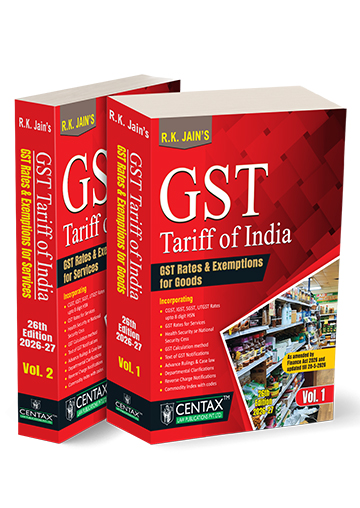
R.K. Jain’s GST Tariff of India is the definitive, single-source ready reference for determining the classification, tax rate, and exemptions for every supply under GST—goods and services alike—in a single integrated two-volume set. Its central design idea is that the user should never have to leave the page: against each entry, it places the CGST, SGST/UTGST, and IGST rates; the exemptions and concessions that bear on it; the reverse-charge position; and the relevant departmental clarifications, advance rulings, and case law. The rate schedules are not printed in isolation but woven into the Customs Tariff up to the eight-digit HSN level, turning a set of bare rate notifications into a true working tariff.
This Edition captures the restructured GST rate framework that took effect on 22nd September 2025, together with the amendments made by the Finance Act 2026—the realignment of the rate schedules and the top rate of 40%. It states the law as current to 20th May 2026, making it a live decision tool for the post-rationalisation regime rather than a historical compilation. Published continuously since 2017, it is the benchmark tariff that trade, industry, the profession and the department rely on.
This publication is indispensable for stakeholders who require accurate, defensible, and audit-ready GST rate and classification outcomes, including:
- Chartered Accountants, Cost Accountants, Company Secretaries and Advocates in GST advisory, compliance and litigation
- GST and Indirect-Tax Consultants settling questions of classification and rate
- Importers, Exporters and EXIM Trade aligning supplies with the HSN/Customs Tariff
- Finance, Accounts, Taxation and Billing Teams in industry computing GST on invoices and supplies
- Departmental Officers and Adjudicating, Appellate and Advance-Ruling Authorities
- Trade Associations, Chambers of Commerce and Businesses across manufacturing, trading and services
- Academicians, Researchers and Candidates for Professional Examinations in indirect taxation
The Present Publication is the 26th Edition | 2026-27, amended by the Finance Act 2026 and updated till 20th May 2026. This book is edited by Centax’s Editorial Board with the following noteworthy features:
- [Eight-Digit HSN Integration with All Four Levies] Rates integrated into the Customs Tariff to the eight-digit HSN level, so each commodity entry—Chapter/Heading/Sub-heading/Tariff Item—carries its CGST, SGST/UTGST and IGST rate side by side in a single table, with the governing rate notification cited against the entry
- [Restructured Rate Schedules, Reproduced in Full] The CGST/IGST rate schedules (notified as Schedules I to VII) are set out and applied; the operative slabs in IGST terms are Nil, 0.25%, 1.5%, 3%, 5%, 18% and 40%, with 18% as the standard and residuary rate for goods not otherwise specified and 40% as the top rate, within the statutory ceiling of 20% (CGST/SGST) and 40% (IGST)
- [Grey-Box Flagging of Non-Standard Entries] Grey-box highlighting wherever the GST schedule departs from the Customs Tariff description, carries more than one rate, or adds a new entry—so non-standard items are caught at a glance
- [Exemptions Surfaced Chapter-by-Chapter] Each chapter is followed by a curated block of the exemptions and concessions that apply to it—threshold exemption, composition and the special composition scheme, concessional and handicraft rates, CSD supplies, second-hand goods, and more—each with its notification citation
- [Dedicated Ready Reckoner for Services] A reckoner for services (Chapter 99) arranged by Service Accounting Code, showing rates and a full conditions/provisos column (including input-tax-credit conditions and valuation provisions) against each heading
- [Full Text of Governing Notifications] Authentic, full text of the rate, exemption, reverse-charge and IGST notifications reproduced—not merely summarised, with substitution and amendment history footnoted
- [Clarifications, Rulings and Case Law in Place] Each subject is enriched with departmental clarifications, circulars, instructions, press notes, advance rulings, FAQs and case law set against the relevant entry
- [Twin Navigation Aids for Goods and Services] A Commodity Index with HSN codes, and codewise plus alphabetical lists of services (SAC)—for rapid look-up from either direction
- [Practitioner’s Analytical Apparatus Up Front] A ‘How to Use this Tariff’ guide; a step-by-step ‘How to Calculate Tax under GST’ method with a worked intra-State vs inter-State illustration; an essay on classification of goods and services (covering composite vs mixed supply and the rules treating certain activities as supply of goods or of services); the Interpretative Rules; and a list of abbreviations
The coverage of the book is as follows:
- Commodity-Wise Goods Rates Across All Four Levies
- GST rates and exemptions on goods under CGST, SGST, UTGST and IGST, arranged commodity-wise to the eight-digit HSN level
- Multi-Chapter and Deemed-Supply Goods
- Miscellaneous goods spanning multiple chapters, and supplies treated as goods through deeming provisions or as actionable claims
- Goods Rate Schedules and Exemptions
- The CGST rate schedules for goods, the list of fully exempt (nil-rated) goods, and miscellaneous exemption notifications
- Duties and Cesses Under Allied Enactments
- Residual Central Excise items, National Calamity Contingent Duty, Additional Duty on Tobacco, Special Additional Excise Duty on motor spirit and high-speed diesel, Road & Infrastructure Cess, and Agriculture Infrastructure & Development Cess
- Health Security se National Security Cess and Tobacco Machinery Rules
- The Cess Act, Rules and FAQs, together with the capacity-based duty rules for chewing tobacco, jarda scented tobacco and gutkha packing machines
- Services Rates, Exemptions and Conditions
- GST rates and exemptions on services under all four levies, indexed by service code, with the conditions attaching to each
- Scheme of Classification of Services
- The Explanatory Notes to the Scheme of Classification of Services
- Reverse Charge Mechanism
- The reverse charge mechanism for goods and services across CGST, IGST, UTGST and SGST
- Integrated Tax (IGST)
- Overview, law and procedure, rates, nil-rated goods and exemptions
- Clarifications, Rulings and Case Law
- Departmental clarifications, advance rulings, FAQs and case law on the supply of goods and services
- Foundational GST Concepts
- Value of supply, composite and mixed supply, the threshold and composition schemes, and HSN-code reporting requirements
- Indexes and Notification History
- A Commodity Index with HSN codes and a chronological list of basic notifications
The work runs across two volumes under a single, continuous pagination, organised into seven Parts.
- Volume 1 — Goods
- Guidance Block | How to Use this Tariff — How to Calculate Tax under GST; Introduction to GST Tariff; Classification of Goods & Services; Interpretative Rules; Abbreviations
- Part 1 | GST Tariff (Goods) — Commodity-wise rates to the eight-digit HSN with CGST, SGST/UTGST and IGST and the chapter-wise exemption blocks, plus a block for miscellaneous and deemed-supply goods
- Part 1A | Rates Specified in Other Acts — Residual excise items, NCCD, additional duty on tobacco, SAED on petrol and diesel, Road & Infrastructure Cess, AIDC, and the Health Security se National Security Cess (Act, Rules, FAQs), with the gutkha/chewing-tobacco capacity rules
- Part 2 | Notifications (GST Rates & Exemptions for Goods) — The CGST rate schedules, the fully exempt (nil-rated) goods, and the miscellaneous exemption notifications
- Volume 2 — Services and Common Material
- Part 3 | GST Tariff (Services, Chapter 99) — The Ready Reckoner with service codes and conditions; the CGST, IGST, UTGST and SGST notifications on services; the Explanatory Notes to the Scheme of Classification; circulars, instructions, press notes, case law, advance rulings and FAQs on services; and codewise and alphabetical lists of services
- Part 4 | Integrated Goods and Services Tax (IGST) — A bird’s-eye view and the full set of IGST notifications (law and procedure, rates, nil-rated goods, exemptions)
- Part 5 | Reverse Charge Mechanism for Goods & Services — The RCM notifications across all four levies, with departmental clarifications
- Part 6 | Commodity Index with HSN Codes
- Part 7 | Chronological List of Basic Notifications