

Description
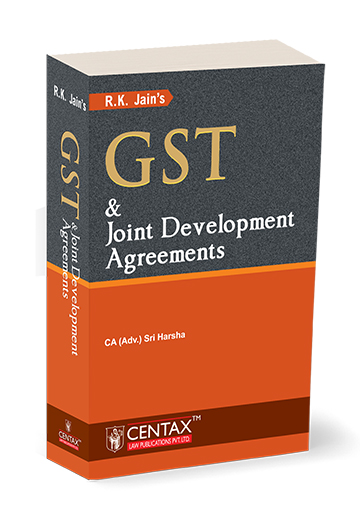
R.K. Jain’s GST & Joint Development Agreements is the first comprehensive, practice-oriented treatise dedicated solely to the GST implications arising from Joint Development Agreements (JDAs) in India’s real estate sector. Based on the author’s decade-long experience advising clients on indirect-tax complexities, this book systematically explains the entire chain of taxable transactions that occur in a JDA—from the transfer of development rights by the landowner to the final sale of flats, units, or plots to end customers. It addresses a long-standing knowledge gap in the industry: while JDAs have become the predominant commercial model for real estate development—especially in markets with high land acquisition costs—the GST framework governing them has developed in a piecemeal and often ambiguous manner. The taxability of different transaction stages has been introduced at various times through notifications, circulars, and legislative amendments. This book traces the complete evolution—from the pre-GST Service Tax regime (post-2012 negative list era), through the GST rollout on 1st July 2017, and the key rate restructuring effective from 1st April 2019—offering readers a comprehensive, timeline-based understanding of the law.
This book is designed for a wide spectrum of professionals and stakeholders engaged with real estate taxation and JDA structuring:
- Chartered Accountants & Tax Consultants advising real estate clients on GST compliance, valuation, input tax credit, and litigation strategy in JDA-based projects
- Advocates & Legal Practitioners engaged in indirect-tax litigation, CESTAT/High Court matters, and advisory mandates involving construction services and development rights
- Real Estate Developers seeking clarity on their tax obligations, both as recipients of development rights and as providers of construction services, across residential, commercial, and plotted development projects
- Land Owners entering or evaluating JDAs who need to understand their GST exposure on TDR supply, construction services received, and downstream flat/plot sales to end customers
- CS, CMA & Other Professionals involved in compliance, due diligence, or transaction structuring for the real estate sector
- Tax Authorities & Revenue Officers looking for a structured, scenario-based reference for assessment and adjudication of JDA-related GST matters
The Present Publication is the 2026 Edition, updated as of 15th February 2026. It is authored by CA. (Adv.) Sri Harsha, with the following noteworthy features:
- [Transaction-based Architecture (T1–T4 Framework)] The book introduces a proprietary four-transaction framework—T1 (Supply of TDRs), T2 (Construction Services to Land Owner), T3 (Sale of Flats/Plots by Developer), and T4 (Sale of Flats/Plots by Land Owner)—providing a structured and replicable methodology for analysing any JDA from the GST perspective
- [Three-aspect Analysis for Every Transaction] Each transaction is thoroughly examined across three dimensions:
- Whether the transaction is taxable or not?
- What the value and applicable rate are?
- When the tax is payable (time of supply?
- It ensures no aspect of compliance is overlooked
- [Complete Evolutionary Coverage] Tracks the taxability of each transaction through different legislative phases—pre-negative list, post-1st July 2012, post-1st July 2017, and post-1st April 2019—enabling practitioners to manage legacy projects and transitional disputes with equal confidence
- [Separate Treatment for Residential, Commercial & Plotted Projects] Recognises that GST treatment varies significantly across project types, dedicating individual chapters to each, with tailored analysis of exemptions, rate structures, and ITC considerations
- [Practical Case Studies with Worked-out Illustrations] Each project chapter concludes with detailed case studies and numerical analyses, translating legal principles into applied tax computations—including invoicing, credit flows, and net tax liability calculations for both landowner and developer
- [Dedicated Issues Chapter] Chapter 9 addresses eight common practical issues through scenario-based analysis—covering transitional JDAs, pre- and post-GST timelines, invoice-raising obligations, set-off mechanics, and eligibility for specific exemptions
- [Input Tax Credit Deep-Dives] Special sections within each project chapter examine ITC implications for landowners and developers—including credit for construction services concerning unsold flats, timing of invoices, credit for TDRs, and the impact of the Vasantha Green Projects ruling
- [Judicial and Circular References Throughout] The discussion is enriched with references to landmark decisions (including the pending Supreme Court cases such as DLF Commercial Projects Corporation and Narne Constructions Pvt. Ltd.), CESTAT rulings, High Court orders, Board Circulars (Circular 151, Circular 177), and key Notifications (4/2018–CT(R), 12/2017–CT(R), etc.).
- [Accessible Language Without Sacrificing Depth] Authored in a practitioner-friendly tone that avoids dense legalese, the book is suitable for non-tax professionals (landowners, developers, project managers) while maintaining the analytical rigour necessary for professional advisory and litigation support
The book covers the complete GST lifecycle of a Joint Development Agreement, encompassing the following core subject areas:
- Transferable Development Rights (TDRs)
- Nature, classification, legislative evolution, and taxability of TDRs under the Service Tax regime and GST—including the ‘mysterious entry’ of TDRs into the tax net via Notification 4/2018–CT(R)
- Construction Services by Developers to Land Owners
- Taxability, valuation (including barter/non-monetary consideration), rate structure, time of supply, and reverse charge implications
- Sale of Flats/Units by Developers to End Customers
- Works contract classification, completion certificate threshold, distinctions between affordable and non-affordable housing, and the 1st April 2019 rate regime
- Sale of Flats/Units by Land Owners to End Customers
- The often-overlooked fourth component of the JDA transaction chain—triggers for taxability, valuation challenges, and ITC eligibility
- Plotted Developments
- A dedicated chapter analysing whether the sale of developed plots falls under ‘sale of land’ (Schedule III) or attracts GST—including discussion on stamp duty evidence, the Gujarat HC ruling in Munjaal Manishbhai Bhat, and the SC decision in Narne Constructions
- Input Tax Credit Mechanics
- A comprehensive overview of ITC flows between land owners and developers—covering invoice timing, credit entitlement for unsold inventory, and the interaction of forward and reverse charge obligations
- Transitional Issues
- The treatment of JDAs entered into before 1st July 2017, but where construction commenced after GST implementation—including the applicability of Section 142(11)(b) and (c) of the CGST Act
The book follows a carefully designed progressive structure:
- Foundational Chapters (Chapters 1–6) — These chapters establish the conceptual groundwork by defining the four transactions (T1–T4), tracing their individual evolutionary taxability timelines from the Service Tax era through successive GST phases, introducing the ITC framework, and setting the analytical context for the detailed chapters that follow
- Residential Projects (Chapters 7–8) — Chapter 7 covers the GST position for JDAs entered after 1st July 2017, while Chapter 8 addresses JDAs entered after 1st April 2019, each providing a comprehensive T1–T4 walkthrough with specific ITC considerations and concluding case studies
- Practical Issues (Chapter 9) — Eight scenario-based issues cover transitional JDAs, supplementary agreements, invoice mechanics, set-off questions, and exemption eligibility, structured as practitioner-ready Q&A discussions
- Commercial Projects (Chapter 10) — Mirrors the residential project analysis for commercial developments, divided into two parts: Part A for post-July 2017 JDAs and Part B for post-April 2019 JDAs, with separate ITC treatment, analysis of Vasantha Green Projects, and detailed case studies
- Plots (Chapter 11) — Dedicated to plotted development JDAs, examining both Model 1 (full stamp duty on developer’s receipts) and Model 2 (partial stamp duty) scenarios, with complete T1–T4 analysis across both GST phases
- Each Chapter Follows a Consistent Internal Structure — Taxable or Not → Value & Rate → Time to Pay Tax → Special ITC Considerations → Case Study → Analysis, making the book highly navigable and ideal for quick reference during advisory or compliance work