

Description
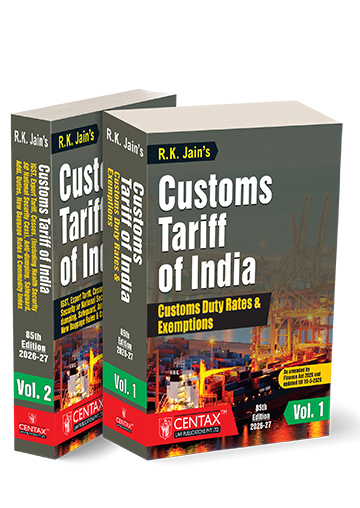
R.K. Jain’s Customs Tariff of India is the authoritative, single-source compilation of the law, rates and exemptions governing the import and export of goods into and out of India. Across two volumes, it brings together the complete Customs Tariff Act 1975, the full Import Tariff (First Schedule) and Export Tariff (Second Schedule), the IGST levy on imports, and every parallel impost that attaches at the border—cesses, surcharges, additional and special duties, and the trade-remedy duties (anti-dumping, countervailing and safeguard). The defining strength of the work is integration: against each tariff heading, the reader finds not only the statutory rate but the effective rate after exemptions, the applicable trade-remedy duties, and the relevant departmental clarifications and case law, so that landed-cost and duty-liability questions can be settled within a single Chapter. This Edition incorporates the newly enacted Health Security se National Security Cess (HSNS Cess) regime and the recast Baggage Rules 2026. In continuous publication since 1979, it remains the standard working tariff of the Indian customs and trade-tax community.
This publication is indispensable for stakeholders who require classification certainty, effective-rate accuracy, exemption defensibility, and audit- or litigation-grade traceability, including:
- Customs And Indirect-Tax Practitioners, Advocates and Chartered Accountants advising on classification, valuation, exemption eligibility and duty computation
- Importers, Exporters, Customs Brokers (CHAs) and EXIM/Foreign-Trade Functions determining landed cost, effective duty and FTA preference
- Customs and CBIC Field Officers—appraising, assessment, audit, SVB and origin-verification groups
- Corporate Indirect-Tax, Supply-Chain, Sourcing and Treasury Teams managing tariff and trade-remedy exposure
- In-House Counsel and Compliance Teams handling anti-dumping, countervailing and safeguard proceedings and refunds
- Academic Institutions, Law and Commerce Libraries, and candidates in indirect-tax and international-trade examinations
The Present Publication is the 85th Edition | 2026-27, amended by Finance Act 2026 and updated till 15th May 2026. This book is edited by Centax’s Editorial Board with the following noteworthy features:
- [Law, Rates and Effective Duty in One Place] Statutory text, the tariff schedules and every linked levy are consolidated so the effective rate of duty can be derived without consulting separate publications
- [Per-Chapter Integrated Treatment] For each tariff Chapter, the basic rate is followed, in a fixed order, by tariff values (where prescribed), anti-dumping and countervailing duties, safeguard duties, exemption notifications, and departmental clarifications and case law
- [Jumbo Exemption Notification] The consolidated exemption and effective-rate notification covering specified goods of Chapters 1 to 98 (read with section 25(4A) of the Customs Act 1962), the principal reference point for concessional and effective rates, is included
- [Updated & Amended] Fully reconciled with the Finance Act 2026 and all subordinate legislation up to the cut-off date; omitted and superseded provisions (e.g. Education Cess, Secondary & Higher Education Cess) are retained as marked entries for continuity
- [Health Security se National Security Cess (HSNS Cess)] The HSNS Cess Act 2025 and HSNS Cess Rules 2026 with departmental FAQs, together with the allied Chewing Tobacco, Jarda Scented Tobacco and Gutkha Packing Machines (Capacity Determination and Collection of Duty) Rules 2026 are included
- [New Baggage Framework] The recast Baggage Rules 2026 and the Customs Baggage (Declaration and Processing) Regulations 2026 are included
- [Latest Trade-Agreement and Assessment Rules] The India–EFTA (TEPA) Rules 2025 and the Customs (Finalisation of Provisional Assessment) Regulations 2025 are included
- [Built-In Computation Guidance] A ‘How to use this Tariff?’ guide and a worked ‘How to calculate the effective rate of import duty’ illustration that sets out the order in which BCD, Social Welfare Surcharge, cesses and IGST are calculated
The coverage of the book is as follows:
- Customs Tariff Act 1975
- The complete bare-Act text, including the charging provision, preferential and trade-agreement rates, protective-duty powers, emergency powers, and the substantive trade-remedy sections (9, 9A, 9AA, 9B, 8B)
- Import Tariff (First Schedule)
- The full Harmonised System classification: 98 Chapters arranged in 21 Sections, with Section Notes, Chapter Notes, Sub-Chapter divisions, the General Rules for Interpretation and the General Explanatory and Additional Notes. The schedule runs the entire commodity spectrum—from live animals, vegetable products and mineral fuels, through chemicals, plastics and textiles, to base metals, machinery, electrical equipment, vehicles, precision instruments, arms, works of art, and the special provisions of Chapter 98 (project imports, laboratory chemicals, passengers’ baggage and personal importation by air or post)
- General Exemptions for Import
- Organised into thematic families covering, among others, imports by privileged persons, organisations and foreigners; training, educational, research and testing imports; oil-exploration and national-programme imports; donations and gifts; sports goods and trophies; imports from specified countries and preferential areas; export-promotion schemes, EOUs and temporary imports; Special Economic Zones; advance authorisation, DFIA, EPCG and replenishment-licence schemes; re-imports; imports for industrial production; and chapter-wise effective rates
- Export Tariff (Second Schedule)
- Commodities liable to export duty, the corresponding export exemptions (re-export of confiscated goods, samples and gifts, specified agricultural and leather goods, etc.), and departmental clarifications and case law
- IGST on Imports
- A bird’s-eye introduction to IGST, extracts of the IGST Act 2017, the IGST Rules, and the rate, exemption and law-and-procedure notifications, supported by commentary on the charge, levy on import of goods, place of supply, reverse charge, apportionment of tax, and the application of CGST provisions to IGST
- Cesses, Additional Duties and Other Levies (Annexures 1–35)
- Social Welfare Surcharge, Road & Infrastructure Cess, Health Cess on imported medical devices, National Calamity Contingent Duty, Agriculture Infrastructure and Development Cess, the GST Compensation Cess position (not leviable from 1st February 2026), CVD and Special Duty, the IGCR (Concessional Rate) Rules 2022, Project Imports Regulations 1986, and the HSNS Cess regime, together with the validating provisions relating to the Customs Tariff
- Trade-Remedy Law
- The rules and rate notifications for anti-dumping duty, countervailing duty on subsidised articles, and the refund of anti-dumping duty paid in excess of the actual margin of dumping, alongside the safeguard-duty and safeguard-measures (quantitative restrictions) framework and the agreement-specific bilateral safeguard rules (India–Singapore, ASEAN, Japan, Korea, Malaysia)
- Rules of Origin
- The determination-of-origin rules for India’s preferential and comprehensive economic agreements—APTA, SAFTA, ASEAN, Japan, Korea, Singapore, Mauritius, UAE, Australia, Chile, MERCOSUR, the DFTP scheme for LDCs, and the new India–EFTA arrangement—and the Customs (Administration of Rules of Origin under Trade Agreements) Rules 2020
- Finding Tools
- A consolidated Commodity Index and a Chronological List of Basic Notifications
The work is organised into nine Parts across two volumes:
- Volume 1 — Custom Duty Rates & Exemptions
- Part 1 — Customs Tariff Act, 1975 (text)
- Part 2 — Import Tariff (First Schedule)
- Volume 2 — IGST, Export Tariff, Cesses, Trade-Remedy Duties, Baggage Rules & Index
- Part 3 — Export Tariff (Second Schedule)
- Part 4 — IGST
- Part 5 — Annexures 1–35 (Cesses, Additional Duties & Other Levies, including the HSNS Cess)
- Part 6 — Safeguard Duty
- Part 7 — Anti-dumping & Countervailing Duty; Part 8 — Miscellaneous (Commodity Index and Chronological List of Basic Notifications)
- Within Part 2, every Chapter follows the same internal sequence—Rules for Interpretation and General Exemptions at the front of the Part, then, Chapter by Chapter, the Section and Chapter Notes followed in fixed order by tariff values, anti-dumping and countervailing duties, safeguard duties, exemption notifications, and departmental clarifications and case law
- This recurring architecture allows the reader to move from a tariff heading to its fully-loaded effective rate within one Chapter, with cross-references pointing to the Annexures in Volume 2 for the levies that stack on top of basic customs duty