


Page 126 - ELT_1_1st April 2020_Vol 372_Part
P. 126
12 EXCISE LAW TIMES [ Vol. 372
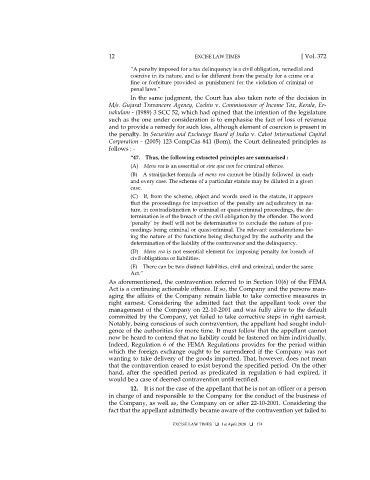
“A penalty imposed for a tax delinquency is a civil obligation, remedial and
coercive in its nature, and is far different from the penalty for a crime or a
fine or forfeiture provided as punishment for the violation of criminal or
penal laws.”
In the same judgment, the Court has also taken note of the decision in
M/s. Gujarat Travancore Agency, Cochin v. Commissioner of Income Tax, Kerala, Er-
nakulam - (1989) 3 SCC 52, which had opined that the intention of the legislature
such as the one under consideration is to emphasise the fact of loss of revenue
and to provide a remedy for such loss, although element of coercion is present in
the penalty. In Securities and Exchange Board of India v. Cabot International Capital
Corporation - (2005) 123 CompCas 841 (Bom), the Court delineated principles as
follows : -
“47. Thus, the following extracted principles are summarised :
(A) Mens rea is an essential or sine qua non for criminal offence.
(B) A straitjacket formula of mens rea cannot be blindly followed in each
and every case. The scheme of a particular statute may be diluted in a given
case.
(C) If, from the scheme, object and words used in the statute, it appears
that the proceedings for imposition of the penalty are adjudicatory in na-
ture, in contradistinction to criminal or quasi-criminal proceedings, the de-
termination is of the breach of the civil obligation by the offender. The word
‘penalty’ by itself will not be determinative to conclude the nature of pro-
ceedings being criminal or quasi-criminal. The relevant considerations be-
ing the nature of the functions being discharged by the authority and the
determination of the liability of the contravenor and the delinquency.
(D) Mens rea is not essential element for imposing penalty for breach of
civil obligations or liabilities.
(E) There can be two distinct liabilities, civil and criminal, under the same
Act.”
As aforementioned, the contravention referred to in Section 10(6) of the FEMA
Act is a continuing actionable offence. If so, the Company and the persons man-
aging the affairs of the Company remain liable to take corrective measures in
right earnest. Considering the admitted fact that the appellant took over the
management of the Company on 22-10-2001 and was fully alive to the default
committed by the Company, yet failed to take corrective steps in right earnest.
Notably, being conscious of such contravention, the appellant had sought indul-
gence of the authorities for more time. It must follow that the appellant cannot
now be heard to contend that no liability could be fastened on him individually.
Indeed, Regulation 6 of the FEMA Regulations provides for the period within
which the foreign exchange ought to be surrendered if the Company was not
wanting to take delivery of the goods imported. That, however, does not mean
that the contravention ceased to exist beyond the specified period. On the other
hand, after the specified period as predicated in regulation 6 had expired, it
would be a case of deemed contravention until rectified.
12. It is not the case of the appellant that he is not an officer or a person
in charge of and responsible to the Company for the conduct of the business of
the Company, as well as, the Company on or after 22-10-2001. Considering the
fact that the appellant admittedly became aware of the contravention yet failed to
EXCISE LAW TIMES 1st April 2020 174

