


Page 297 - ELT_1_1st April 2020_Vol 372_Part
P. 297
2020 ] COMMR. OF C. EX. & SERVICE TAX, JAMMU & KASHMIR v. GRAVITA METALS 183
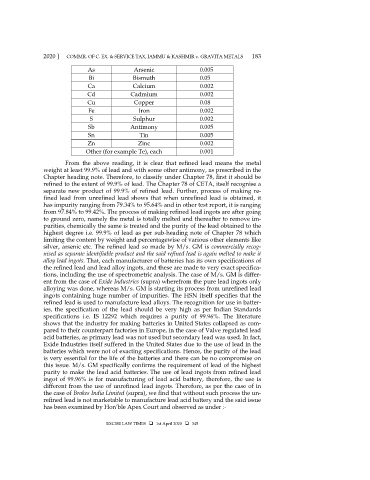
As Arsenic 0.005
Bi Bismuth 0.05
Ca Calcium 0.002
Cd Cadmium 0.002
Cu Copper 0.08
Fe Iron 0.002
S Sulphur 0.002
Sb Antimony 0.005
Sn Tin 0.005
Zn Zinc 0.002
Other (for example Te), each 0.001
From the above reading, it is clear that refined lead means the metal
weight at least 99.9% of lead and with some other antimony, as prescribed in the
Chapter heading note. Therefore, to classify under Chapter 78, first it should be
refined to the extent of 99.9% of lead. The Chapter 78 of CETA, itself recognise a
separate new product of 99.9% of refined lead. Further, process of making re-
fined lead from unrefined lead shows that when unrefined lead is obtained, it
has impurity ranging from 79.34% to 95.64% and in other test report, it is ranging
from 97.84% to 99.42%. The process of making refined lead ingots are after going
to ground zero, namely the metal is totally melted and thereafter to remove im-
purities, chemically the same is treated and the purity of the lead obtained to the
highest degree i.e. 99.9% of lead as per sub-heading note of Chapter 78 which
limiting the content by weight and percentagewise of various other elements like
silver, arsenic etc. The refined lead so made by M/s. GM is commercially recog-
nised as separate identifiable product and the said refined lead is again melted to make it
alloy lead ingots. That, each manufacturer of batteries has its own specifications of
the refined lead and lead alloy ingots, and these are made to very exact specifica-
tions, including the use of spectrometric analysis. The case of M/s. GM is differ-
ent from the case of Exide Industries (supra) wherefrom the pure lead ingots only
alloying was done, whereas M/s. GM is starting its process from unrefined lead
ingots containing huge number of impurities. The HSN itself specifies that the
refined lead is used to manufacture lead alloys. The recognition for use in batter-
ies, the specification of the lead should be very high as per Indian Standards
specifications i.e. IS 12292 which requires a purity of 99.96%. The literature
shows that the industry for making batteries in United States collapsed as com-
pared to their counterpart factories in Europe, in the case of Valve regulated lead
acid batteries, as primary lead was not used but secondary lead was used. In fact,
Exide Industries itself suffered in the United States due to the use of lead in the
batteries which were not of exacting specifications. Hence, the purity of the lead
is very essential for the life of the batteries and there can be no compromise on
this issue. M/s. GM specifically confirms the requirement of lead of the highest
purity to make the lead acid batteries. The use of lead ingots from refined lead
ingot of 99.96% is for manufacturing of lead acid battery, therefore, the use is
different from the use of unrefined lead ingots. Therefore, as per the case of in
the case of Brakes India Limited (supra), we find that without such process the un-
refined lead is not marketable to manufacture lead acid battery and the said issue
has been examined by Hon’ble Apex Court and observed as under :-
EXCISE LAW TIMES 1st April 2020 345

