


Page 259 - ELT_1st September 2020_Vol 373_Part 5
P. 259
2020 ] COMMR OF CUS., C. EX. & S.T., HYDERABAD-II v. G.M.K. PRODUCTS PVT. LTD. 697
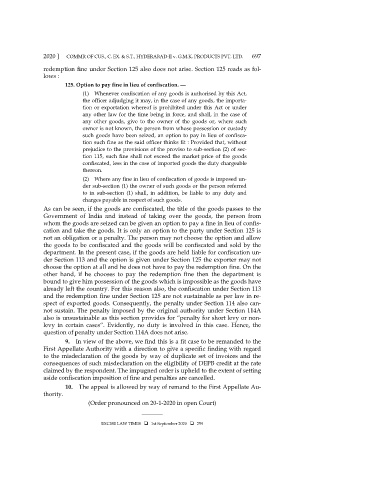
redemption fine under Section 125 also does not arise. Section 125 reads as fol-
lows :
125. Option to pay fine in lieu of confiscation. —
(1) Whenever confiscation of any goods is authorised by this Act,
the officer adjudging it may, in the case of any goods, the importa-
tion or exportation whereof is prohibited under this Act or under
any other law for the time being in force, and shall, in the case of
any other goods, give to the owner of the goods or, where such
owner is not known, the person from whose possession or custody
such goods have been seized, an option to pay in lieu of confisca-
tion such fine as the said officer thinks fit : Provided that, without
prejudice to the provisions of the proviso to sub-section (2) of sec-
tion 115, such fine shall not exceed the market price of the goods
confiscated, less in the case of imported goods the duty chargeable
thereon.
(2) Where any fine in lieu of confiscation of goods is imposed un-
der sub-section (1) the owner of such goods or the person referred
to in sub-section (1) shall, in addition, be liable to any duty and
charges payable in respect of such goods.
As can be seen, if the goods are confiscated, the title of the goods passes to the
Government of India and instead of taking over the goods, the person from
whom the goods are seized can be given an option to pay a fine in lieu of confis-
cation and take the goods. It is only an option to the party under Section 125 is
not an obligation or a penalty. The person may not choose the option and allow
the goods to be confiscated and the goods will be confiscated and sold by the
department. In the present case, if the goods are held liable for confiscation un-
der Section 113 and the option is given under Section 125 the exporter may not
choose the option at all and he does not have to pay the redemption fine. On the
other hand, if he chooses to pay the redemption fine then the department is
bound to give him possession of the goods which is impossible as the goods have
already left the country. For this reason also, the confiscation under Section 113
and the redemption fine under Section 125 are not sustainable as per law in re-
spect of exported goods. Consequently, the penalty under Section 114 also can-
not sustain. The penalty imposed by the original authority under Section 114A
also is unsustainable as this section provides for “penalty for short levy or non-
levy in certain cases”. Evidently, no duty is involved in this case. Hence, the
question of penalty under Section 114A does not arise.
9. In view of the above, we find this is a fit case to be remanded to the
First Appellate Authority with a direction to give a specific finding with regard
to the misdeclaration of the goods by way of duplicate set of invoices and the
consequences of such misdeclaration on the eligibility of DEPB credit at the rate
claimed by the respondent. The impugned order is upheld to the extent of setting
aside confiscation imposition of fine and penalties are cancelled.
10. The appeal is allowed by way of remand to the First Appellate Au-
thority.
(Order pronounced on 20-1-2020 in open Court)
_______
EXCISE LAW TIMES 1st September 2020 259

