


Page 168 - GSTL_26th March 2020_Vol 34_Part 4
P. 168
678 GST LAW TIMES [ Vol. 34
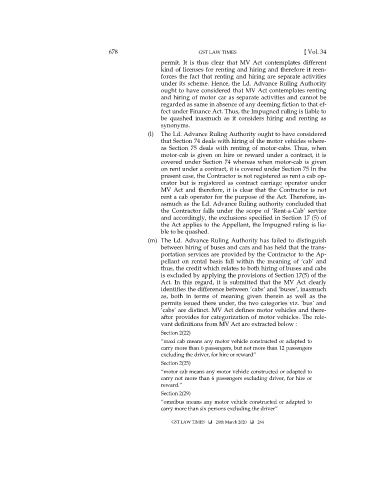
permit. It is thus clear that MV Act contemplates different
kind of licenses for renting and hiring and therefore it reen-
forces the fact that renting and hiring are separate activities
under its scheme. Hence, the Ld. Advance Ruling Authority
ought to have considered that MV Act contemplates renting
and hiring of motor car as separate activities and cannot be
regarded as same in absence of any deeming fiction to that ef-
fect under Finance Act. Thus, the Impugned ruling is liable to
be quashed inasmuch as it considers hiring and renting as
synonyms.
(l) The Ld. Advance Ruling Authority ought to have considered
that Section 74 deals with hiring of the motor vehicles where-
as Section 75 deals with renting of motor-cabs. Thus, when
motor-cab is given on hire or reward under a contract, it is
covered under Section 74 whereas when motor-cab is given
on rent under a contract, it is covered under Section 75 In the
present case, the Contractor is not registered as rent a cab op-
erator but is registered as contract carriage operator under
MV Act and therefore, it is clear that the Contractor is not
rent a cab operator for the purpose of the Act. Therefore, in-
asmuch as the Ld. Advance Ruling authority concluded that
the Contractor falls under the scope of ‘Rent-a-Cab’ service
and accordingly, the exclusions specified in Section 17 (5) of
the Act applies to the Appellant, the Impugned ruling is lia-
ble to be quashed.
(m) The Ld. Advance Ruling Authority has failed to distinguish
between hiring of buses and cars and has held that the trans-
portation services are provided by the Contractor to the Ap-
pellant on rental basis fall within the meaning of ‘cab’ and
thus, the credit which relates to both hiring of buses and cabs
is excluded by applying the provisions of Section 17(5) of the
Act. In this regard, it is submitted that the MV Act clearly
identifies the difference between ‘cabs’ and ‘buses’, inasmuch
as, both in terms of meaning given therein as well as the
permits issued there under, the two categories viz. ‘bus’ and
‘cabs’ are distinct. MV Act defines motor vehicles and there-
after provides for categorization of motor vehicles. The rele-
vant definitions from MV Act are extracted below :
Section 2(22)
“maxi cab means any motor vehicle constructed or adapted to
carry more than 6 passengers, but not more than 12 passengers
excluding the driver, for hire or reward”
Section 2(25)
“motor cab means any motor vehicle constructed or adapted to
carry not more than 6 passengers excluding driver, for hire or
reward.”
Section 2(29)
“omnibus means any motor vehicle constructed or adapted to
carry more than six persons excluding the driver”
GST LAW TIMES 26th March 2020 264

