


Page 200 - GSTL_2nd April 2020_Vol 35_Part 1
P. 200
102 GST LAW TIMES [ Vol. 35
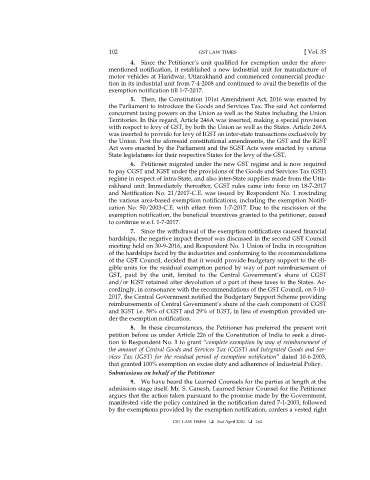
4. Since the Petitioner’s unit qualified for exemption under the afore-
mentioned notification, it established a new industrial unit for manufacture of
motor vehicles at Haridwar, Uttarakhand and commenced commercial produc-
tion in its industrial unit from 7-4-2008 and continued to avail the benefits of the
exemption notification till 1-7-2017.
5. Then, the Constitution 101st Amendment Act, 2016 was enacted by
the Parliament to introduce the Goods and Services Tax. The said Act conferred
concurrent taxing powers on the Union as well as the States including the Union
Territories. In this regard, Article 246A was inserted, making a special provision
with respect to levy of GST, by both the Union as well as the States. Article 269A
was inserted to provide for levy of IGST on inter-state transactions exclusively by
the Union. Post the aforesaid constitutional amendments, the GST and the IGST
Act were enacted by the Parliament and the SGST Acts were enacted by various
State legislatures for their respective States for the levy of the GST.
6. Petitioner migrated under the new GST regime and is now required
to pay CGST and IGST under the provisions of the Goods and Services Tax (GST)
regime in respect of intra-State, and also inter-State supplies made from the Utta-
rakhand unit. Immediately thereafter, CGST rules came into force on 18-7-2017
and Notification No. 21/2017-C.E. was issued by Respondent No. 1 rescinding
the various area-based exemption notifications, including the exemption Notifi-
cation No. 50/2003-C.E. with effect from 1-7-2017. Due to the rescission of the
exemption notification, the beneficial incentives granted to the petitioner, ceased
to continue w.e.f. 1-7-2017.
7. Since the withdrawal of the exemption notifications caused financial
hardships, the negative impact thereof was discussed in the second GST Council
meeting held on 30-9-2016, and Respondent No. 1 Union of India in recognition
of the hardships faced by the industries and conforming to the recommendations
of the GST Council, decided that it would provide budgetary support to the eli-
gible units for the residual exemption period by way of part reimbursement of
GST, paid by the unit, limited to the Central Government’s share of CGST
and/or IGST retained after devolution of a part of these taxes to the States. Ac-
cordingly, in consonance with the recommendations of the GST Council, on 5-10-
2017, the Central Government notified the Budgetary Support Scheme providing
reimbursements of Central Government’s share of the cash component of CGST
and IGST i.e. 58% of CGST and 29% of IGST, in lieu of exemption provided un-
der the exemption notification.
8. In these circumstances, the Petitioner has preferred the present writ
petition before us under Article 226 of the Constitution of India to seek a direc-
tion to Respondent No. 1 to grant “complete exemption by way of reimbursement of
the amount of Central Goods and Services Tax (CGST) and Integrated Goods and Ser-
vices Tax (IGST) for the residual period of exemption notification” dated 10-6-2003,
that granted 100% exemption on excise duty and adherence of Industrial Policy.
Submissions on behalf of the Petitioner
9. We have heard the Learned Counsels for the parties at length at the
admission stage itself. Mr. S. Ganesh, Learned Senior Counsel for the Petitioner
argues that the action taken pursuant to the promise made by the Government,
manifested vide the policy contained in the notification dated 7-1-2003, followed
by the exemptions provided by the exemption notification, confers a vested right
GST LAW TIMES 2nd April 2020 264

