


Page 206 - GSTL_2nd April 2020_Vol 35_Part 1
P. 206
108 GST LAW TIMES [ Vol. 35
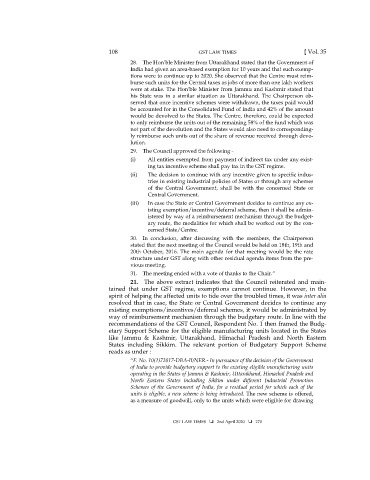
28. The Hon’ble Minister from Uttarakhand stated that the Government of
India had given an area-based exemption for 10 years and that such exemp-
tions were to continue up to 2020. She observed that the Centre must reim-
burse such units for the Central taxes as jobs of more than one lakh workers
were at stake. The Hon’ble Minister from Jammu and Kashmir stated that
his State was in a similar situation as Uttarakhand. The Chairperson ob-
served that once incentive schemes were withdrawn, the taxes paid would
be accounted for in the Consolidated Fund of India and 42% of the amount
would be devolved to the States. The Centre, therefore, could be expected
to only reimburse the units out of the remaining 58% of the fund which was
not part of the devolution and the States would also need to corresponding-
ly reimburse such units out of the share of revenue received through devo-
lution.
29. The Council approved the following -
(i) All entities exempted from payment of indirect tax under any exist-
ing tax incentive scheme shall pay tax in the GST regime.
(ii) The decision to continue with any incentive given to specific indus-
tries in existing industrial policies of States or through any schemes
of the Central Government, shall be with the concerned State or
Central Government.
(iii) In case the State or Central Government decides to continue any ex-
isting exemption/incentive/deferral scheme, then it shall be admin-
istered by way of a reimbursement mechanism through the budget-
ary route, the modalities for which shall be worked out by the con-
cerned State/Centre.
30. In conclusion, after discussing with the members, the Chairperson
stated that the next meeting of the Council would be held on 18th, 19th and
20th October, 2016. The main agenda for that meeting would be the rate
structure under GST along with other residual agenda items from the pre-
vious meeting.
31. The meeting ended with a vote of thanks to the Chair.“
21. The above extract indicates that the Council reiterated and main-
tained that under GST regime, exemptions cannot continue. However, in the
spirit of helping the affected units to tide over the troubled times, it was inter alia
resolved that in case, the State or Central Government decides to continue any
existing exemptions/incentives/deferral schemes, it would be administrated by
way of reimbursement mechanism through the budgetary route. In line with the
recommendations of the GST Council, Respondent No. 1 then framed the Budg-
etary Support Scheme for the eligible manufacturing units located in the States
like Jammu & Kashmir, Uttarakhand, Himachal Pradesh and North Eastern
States including Sikkim. The relevant portion of Budgetary Support Scheme
reads as under :
“F. No. 10(1)72017-DBA-II/NER.- In pursuance of the decision of the Government
of India to provide budgetary support to the existing eligible manufacturing units
operating in the States of Jammu & Kashmir, Uttarakhand, Himachal Pradesh and
North Eastern States including Sikkim under different Industrial Promotion
Schemes of the Government of India, for a residual period for which each of the
units is eligible, a new scheme is being introduced. The new scheme is offered,
as a measure of goodwill, only to the units which were eligible for drawing
GST LAW TIMES 2nd April 2020 270

