


Page 141 - GSTL_7th May 2020_Vol 36_Part 1
P. 141
2020 ] IN RE : SATYESH BRINECHEM PRIVATE LIMITED 99
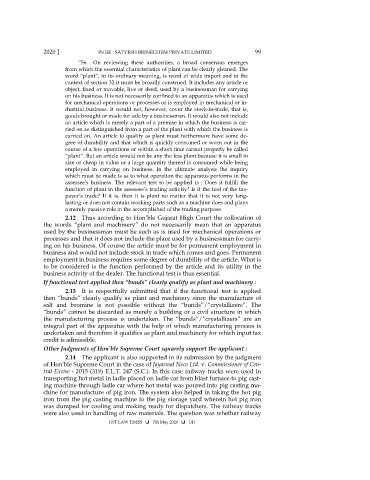
”56. On reviewing these authorities, a broad consensus emerges
from which the essential characteristics of plant can be clearly gleaned. The
word “plant”, in its ordinary meaning, is word of wide import and in the
context of section 32 it must be broadly construed. It includes any article or
object, fixed or movable, live or deed, used by a businessman for carrying
on his business. It is not necessarily confined to an apparatus which is used
for mechanical operations or processes or is employed in mechanical or in-
dustrial business. It would not, however, cover the stock-in-trade, that is,
goods brought or made for sale by a businessman. It would also not include
an article which is merely a part of a premise in which the business is car-
ried on as distinguished from a part of the plant with which the business is
carried on. An article to qualify as plant must furthermore have some de-
gree of durability and that which is quickly consumed or worn out in the
course of a few operations or within a short time cannot properly be called
“plant”. But an article would not be any the less plant because it is small in
size or cheap in value or a large quantity thereof is consumed while being
employed in carrying on business. In the ultimate analysis the inquiry
which must be made is as to what operation the apparatus performs in the
assessee's business. The relevant test to be applied is : Does it fulfill the
function of plant in the assessee’s trading activity? Is it the tool of the tax-
payer’s trade? If it is, then it is plant no matter that it is not very long-
lasting or does not contain working parts such as a machine does and plays
a merely passive role in the accomplished of the trading purpose.
2.12 Thus according to Hon’ble Gujarat High Court the collocation of
the words “plant and machinery” do not necessarily mean that an apparatus
used by the businessman must be such as is used for mechanical operations or
processes and that it does not include the place used by a businessman for carry-
ing on his business. Of course the article must be for permanent employment in
business and would not include stock in trade which comes and goes. Permanent
employment in business requires some degree of durability of the article. What is
to be considered is the function performed by the article and its utility in the
business activity of the dealer. The functional test is thus essential.
If functional test applied then “bunds” clearly qualify as plant and machinery :
2.13 It is respectfully submitted that if the functional test is applied
then “bunds” clearly qualify as plant and machinery since the manufacture of
salt and bromine is not possible without the “bunds”/“crystallizers”. The
“bunds” cannot be discarded as merely a building or a civil structure in which
the manufacturing process is undertaken. The “bunds”/“crystallizers” are an
integral part of the apparatus with the help of which manufacturing process is
undertaken and therefore it qualifies as plant and machinery for which input tax
credit is admissible.
Other Judgments of Hon’ble Supreme Court squarely support the applicant :
2.14 The applicant is also supported in its submission by the judgment
of Hon’ble Supreme Court in the case of Jayaswal Neco Ltd. v. Commissioner of Cen-
tral Excise - 2015 (319) E.L.T. 247 (S.C.). In this case railway tracks were used in
transporting hot metal in ladle placed on ladle car from blast furnace to pig cast-
ing machine through ladle car where hot metal was poured into pig casting ma-
chine for manufacture of pig iron. The system also helped in taking the hot pig
iron from the pig casting machine to the pig storage yard wherein hot pig iron
was dumped for cooling and making ready for dispatchers. The railway tracks
were also used in handling of raw materials. The question was whether railway
GST LAW TIMES 7th May 2020 141

