


Page 124 - GSTL_6th August 2020_Vol 39_Part 1
P. 124
50 GST LAW TIMES [ Vol. 39
ble rate of knitted fabrics is a single rate irrespective of their constituent materi-
als, i.e., Cotton (100%) or 100% of Polyester/Viscose/Rayon/Nylon or blended
of any nature. The applicable rate is 2.5% CGST provided vide Sl. No. 221 of
Schedule-I of Notification 1/2017-C.T. (R), dated 28-6-2017 as amended and 2.5%
SGST provided vide S. No. 221 of Schedule-I of Notification No.
II(2)/CTR/532(d-4)/2017 vide G.O. (Ms) No. 62, dated 29-6-2017.
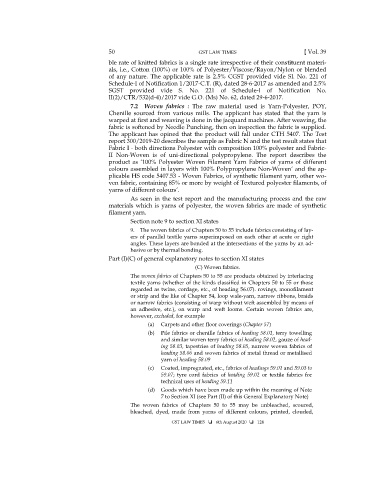
7.2 Woven fabrics : The raw material used is Yarn-Polyester, POY,
Chenille sourced from various mills. The applicant has stated that the yarn is
warped at first and weaving is done in the jacquard machines. After weaving, the
fabric is softened by Needle Punching, then on inspection the fabric is supplied.
The applicant has opined that the product will fall under CTH 5407. The Test
report 300/2019-20 describes the sample as Fabric N and the test result states that
Fabric I - both directions Polyester with composition 100% polyester and Fabric-
II Non-Woven is of uni-directional polypropylene. The report describes the
product as ‘100% Polyester Woven Filament Yarn Fabrics of yarns of different
colours assembled in layers with 100% Polypropylene Non-Woven’ and the ap-
plicable HS code 5407.53 - Woven Fabrics, of synthetic filament yarn, other wo-
ven fabric, containing 85% or more by weight of Textured polyester filaments, of
yarns of different colours’.
As seen in the test report and the manufacturing process and the raw
materials which is yarns of polyester, the woven fabrics are made of synthetic
filament yarn.
Section note 9 to section XI states
9. The woven fabrics of Chapters 50 to 55 include fabrics consisting of lay-
ers of parallel textile yarns superimposed on each other at acute or right
angles. These layers are bonded at the intersections of the yarns by an ad-
hesive or by thermal bonding.
Part (I)(C) of general explanatory notes to section XI states
(C) Woven fabrics.
The woven fabrics of Chapters 50 to 55 are products obtained by interlacing
textile yarns (whether of the kinds classified in Chapters 50 to 55 or those
regarded as twine, cordage, etc., of heading 56.07). rovings, monofilament
or strip and the like of Chapter 54, loop wale-yarn, narrow ribbons, braids
or narrow fabrics (consisting of warp without weft assembled by means of
an adhesive, etc.), on warp and weft looms. Certain woven fabrics are,
however, excluded, for example
(a) Carpets and other floor coverings (Chapter 57)
(b) Pile fabrics or chenille fabrics of heading 58.01, terry towelling
and similar woven terry fabrics of heading 58.02, gauze of head-
ing 58.03, tapestries of heading 58.05, narrow woven fabrics of
heading 58.06 and woven fabrics of metal thread or metallised
yarn of heading 58.09
(c) Coated, impregnated, etc., fabrics of headings 59.01 and 59.03 to
59.07; tyre cord fabrics of heading 59.02 or textile fabrics for
technical uses of heading 59.11
(d) Goods which have been made up within the meaning of Note
7 to Section XI (see Part (II) of this General Explanatory Note)
The woven fabrics of Chapters 50 to 55 may be unbleached, scoured,
bleached, dyed, made from yarns of different colours, printed, clouded,
GST LAW TIMES 6th August 2020 124

