


Page 41 - ELT_1_1st April 2020_Vol 372_Part
P. 41
2020 ] DEPARTMENTAL APPROACH & SUCCESS OF SABKA VISHWAS SCHEME, 2019 A15
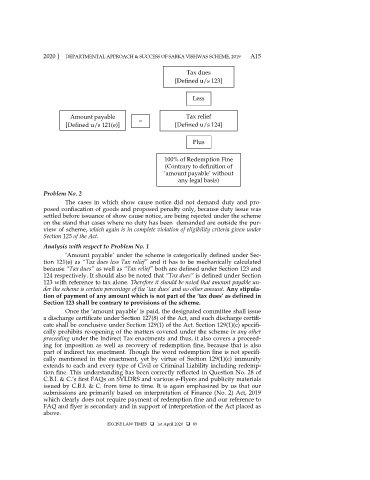
Tax dues
[Defined u/s 123]
Less
Amount payable Tax relief
[Defined u/s 121(e)] = [Defined u/s 124]
Plus
100% of Redemption Fine
(Contrary to definition of
‘amount payable’ without
any legal basis)
Problem No. 2
The cases in which show cause notice did not demand duty and pro-
posed confiscation of goods and proposed penalty only, because duty issue was
settled before issuance of show cause notice, are being rejected under the scheme
on the stand that cases where no duty has been demanded are outside the pur-
view of scheme, which again is in complete violation of eligibility criteria given under
Section 125 of the Act.
Analysis with respect to Problem No. 1
‘Amount payable’ under the scheme is categorically defined under Sec-
tion 121(e) as “Tax dues less Tax relief” and it has to be mechanically calculated
because “Tax dues” as well as “Tax relief” both are defined under Section 123 and
124 respectively. It should also be noted that “Tax dues” is defined under Section
123 with reference to tax alone. Therefore it should be noted that amount payable un-
der the scheme is certain percentage of the ‘tax dues’ and no other amount. Any stipula-
tion of payment of any amount which is not part of the ‘tax dues’ as defined in
Section 123 shall be contrary to provisions of the scheme.
Once the ‘amount payable’ is paid, the designated committee shall issue
a discharge certificate under Section 127(8) of the Act, and such discharge certifi-
cate shall be conclusive under Section 129(1) of the Act. Section 129(1)(c) specifi-
cally prohibits re-opening of the matters covered under the scheme in any other
proceeding under the Indirect Tax enactments and thus, it also covers a proceed-
ing for imposition as well as recovery of redemption fine, because that is also
part of indirect tax enactment. Though the word redemption fine is not specifi-
cally mentioned in the enactment, yet by virtue of Section 129(1)(c) immunity
extends to each and every type of Civil or Criminal Liability including redemp-
tion fine. This understanding has been correctly reflected in Question No. 28 of
C.B.I. & C.’s first FAQs on SVLDRS and various e-Flyers and publicity materials
issued by C.B.I. & C. from time to time. It is again emphasized by us that our
submissions are primarily based on interpretation of Finance (No. 2) Act, 2019
which clearly does not require payment of redemption fine and our reference to
FAQ and flyer is secondary and in support of interpretation of the Act placed as
above.
EXCISE LAW TIMES 1st April 2020 89

