


Page 135 - GSTL_26th March 2020_Vol 34_Part 4
P. 135
2020 ] IN RE : ELECTROPLATING AND METAL FINISHERS 645
6.4 Job-work is defined under Section 2(68) as below :
Section 2(68) of CGST Act defines “Job work means any treatment or pro-
cess undertaken by a person on goods belonging to another registered per-
son and the expression “job worker’ shall be construed accordingly.
Thus the activity of undertaking manufacturing services by a registered person
on the physical inputs owned by another registered person is a ‘job work’. In the
case at hand, the applicant is a registered person and when he undertakes elec-
troplating activities on the goods belonging to another registered person, then
the nature of work of the applicant is “Job work”.
7.1 The applicable rate of Service Tax is given vide Notification No.
11/2017-C.T. (Rate), dated 28-6-2017, the relevant portion of which is extracted
below :
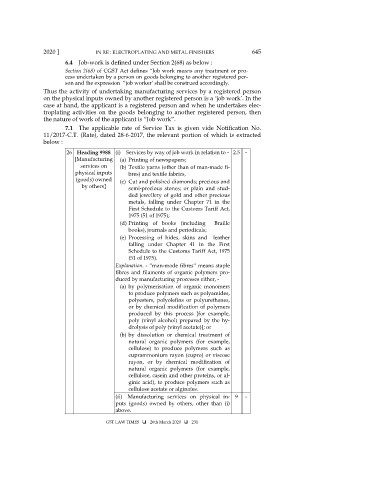
26 Heading 9988 (i) Services by way of job work in relation to - 2.5 -
[Manufacturing (a) Printing of newspapers;
services on (b) Textile yarns (other than of man-made fi-
physical inputs bres) and textile fabrics,
(goods) owned (c) Cut and polished diamonds; precious and
by others] semi-precious stones; or plain and stud-
ded jewellery of gold and other precious
metals, falling under Chapter 71 in the
First Schedule to the Customs Tariff Act,
1975 (51 of 1975);
(d) Printing of books (including Braille
books), journals and periodicals;
(e) Processing of hides, skins and leather
falling under Chapter 41 in the First
Schedule to the Customs Tariff Act, 1975
(51 of 1975).
Explanation. - “man-made fibres“ means staple
fibres and filaments of organic polymers pro-
duced by manufacturing processes either, -
(a) by polymerisation of organic monomers
to produce polymers such as polyamides,
polyesters, polyolefins or polyurethanes,
or by chemical modification of polymers
produced by this process [for example,
poly (vinyl alcohol) prepared by the hy-
drolysis of poly (vinyl acetate)]; or
(b) by dissolution or chemical treatment of
natural organic polymers (for example,
cellulose) to produce polymers such as
cuprammonium rayon (cupro) or viscose
rayon, or by chemical modification of
natural organic polymers (for example,
cellulose, casein and other proteins, or al-
ginic acid), to produce polymers such as
cellulose acetate or alginates.
(ii) Manufacturing services on physical in- 9 -
puts (goods) owned by others, other than (i)
above.
GST LAW TIMES 26th March 2020 231

