


Page 39 - GSTL_11th June 2020_Vol 37_Part 2
P. 39
2020 ] RECOVERY OF ARREARS UNDER GST — A COMPLETE ANALYSIS J47
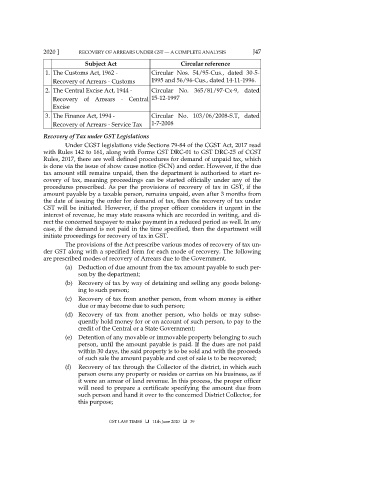
Subject Act Circular reference
1. The Customs Act, 1962 - Circular Nos. 54/95-Cus., dated 30-5-
Recovery of Arrears - Customs 1995 and 56/96-Cus., dated 14-11-1996.
2. The Central Excise Act, 1944 - Circular No. 365/81/97-Cx-9, dated
Recovery of Arrears - Central 15-12-1997
Excise
3. The Finance Act, 1994 - Circular No. 103/06/2008-S.T, dated
Recovery of Arrears - Service Tax 1-7-2008
Recovery of Tax under GST Legislations
Under CGST legislations vide Sections 79-84 of the CGST Act, 2017 read
with Rules 142 to 161, along with Forms GST DRC-01 to GST DRC-25 of CGST
Rules, 2017, there are well defined procedures for demand of unpaid tax, which
is done via the issue of show cause notice (SCN) and order. However, if the due
tax amount still remains unpaid, then the department is authorised to start re-
covery of tax, meaning proceedings can be started officially under any of the
procedures prescribed. As per the provisions of recovery of tax in GST, if the
amount payable by a taxable person, remains unpaid, even after 3 months from
the date of issuing the order for demand of tax, then the recovery of tax under
GST will be initiated. However, if the proper officer considers it urgent in the
interest of revenue, he may state reasons which are recorded in writing, and di-
rect the concerned taxpayer to make payment in a reduced period as well. In any
case, if the demand is not paid in the time specified, then the department will
initiate proceedings for recovery of tax in GST.
The provisions of the Act prescribe various modes of recovery of tax un-
der GST along with a specified form for each mode of recovery. The following
are prescribed modes of recovery of Arrears due to the Government.
(a) Deduction of due amount from the tax amount payable to such per-
son by the department;
(b) Recovery of tax by way of detaining and selling any goods belong-
ing to such person;
(c) Recovery of tax from another person, from whom money is either
due or may become due to such person;
(d) Recovery of tax from another person, who holds or may subse-
quently hold money for or on account of such person, to pay to the
credit of the Central or a State Government;
(e) Detention of any movable or immovable property belonging to such
person, until the amount payable is paid. If the dues are not paid
within 30 days, the said property is to be sold and with the proceeds
of such sale the amount payable and cost of sale is to be recovered;
(f) Recovery of tax through the Collector of the district, in which such
person owns any property or resides or carries on his business, as if
it were an arrear of land revenue. In this process, the proper officer
will need to prepare a certificate specifying the amount due from
such person and hand it over to the concerned District Collector, for
this purpose;
GST LAW TIMES 11th June 2020 39

