


Page 79 - GSTL_18th June 2020_Vol 37_Part 3
P. 79
2020 ] ULTRA TECH NATHDWARA CEMENT LTD. v. UNION OF INDIA 293
“(a) admit and allow the appeal filed by the appellant against the im-
pugned Final Judgment dated 14-11-2018 passed by the Hon’ble Na-
tional Company Law Appellate Tribunal, New Delhi in Company
Appeal (AT) (Insolvency) Nos. 82, 123, 188, 216 & 234 of 2018; and/or
(b) pass any other or further orders which Your Lordships may deem to
be fit and proper in the interest of justice.”
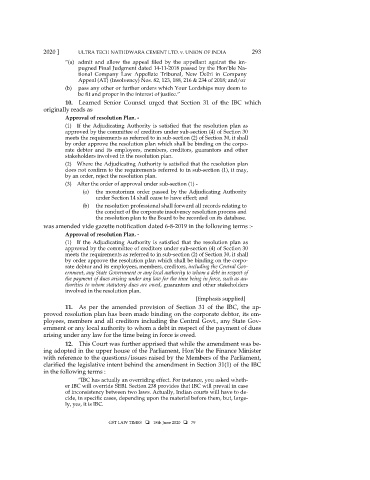
10. Learned Senior Counsel urged that Section 31 of the IBC which
originally reads as
Approval of resolution Plan. -
(1) If the Adjudicating Authority is satisfied that the resolution plan as
approved by the committee of creditors under sub-section (4) of Section 30
meets the requirements as referred to in sub-section (2) of Section 30, it shall
by order approve the resolution plan which shall be binding on the corpo-
rate debtor and its employees, members, creditors, guarantors and other
stakeholders involved in the resolution plan.
(2) Where the Adjudicating Authority is satisfied that the resolution plan
does not confirm to the requirements referred to in sub-section (1), it may,
by an order, reject the resolution plan.
(3) After the order of approval under sub-section (1) -
(a) the moratorium order passed by the Adjudicating Authority
under Section 14 shall cease to have effect; and
(b) the resolution professional shall forward all records relating to
the conduct of the corporate insolvency resolution process and
the resolution plan to the Board to be recorded on its database.
was amended vide gazette notification dated 6-8-2019 in the following terms :-
Approval of resolution Plan. -
(1) If the Adjudicating Authority is satisfied that the resolution plan as
approved by the committee of creditors under sub-section (4) of Section 30
meets the requirements as referred to in sub-section (2) of Section 30, it shall
by order approve the resolution plan which shall be binding on the corpo-
rate debtor and its employees, members, creditors, including the Central Gov-
ernment, any State Government or any local authority to whom a debt in respect of
the payment of dues arising under any law for the time being in force, such as au-
thorities to whom statutory dues are owed, guarantors and other stakeholders
involved in the resolution plan.
[Emphasis supplied]
11. As per the amended provision of Section 31 of the IBC, the ap-
proved resolution plan has been made binding on the corporate debtor, its em-
ployees, members and all creditors including the Central Govt., any State Gov-
ernment or any local authority to whom a debt in respect of the payment of dues
arising under any law for the time being in force is owed.
12. This Court was further apprised that while the amendment was be-
ing adopted in the upper house of the Parliament, Hon’ble the Finance Minister
with reference to the questions/issues raised by the Members of the Parliament,
clarified the legislative intent behind the amendment in Section 31(1) of the IBC
in the following terms :
“IBC has actually an overriding effect. For instance, you asked wheth-
er IBC will override SEBI. Section 238 provides that IBC will prevail in case
of inconsistency between two laws. Actually, Indian courts will have to de-
cide, in specific cases, depending upon the material before them, but, large-
ly, yes, it is IBC.
GST LAW TIMES 18th June 2020 79

