


Page 69 - ELT_15th June 2020_VOL 372_Part 6th
P. 69
2020 ] DEPARTMENTAL CLARIFICATIONS T35
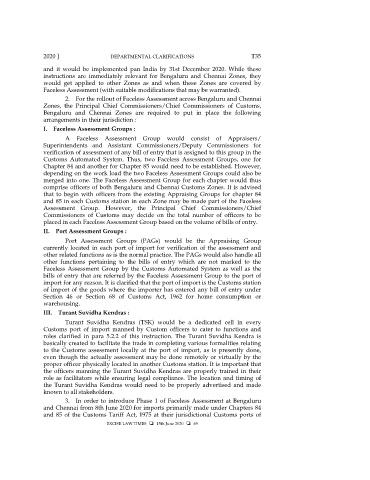
and it would be implemented pan India by 31st December 2020. While these
instructions are immediately relevant for Bengaluru and Chennai Zones, they
would get applied to other Zones as and when these Zones are covered by
Faceless Assessment (with suitable modifications that may be warranted).
2. For the rollout of Faceless Assessment across Bengaluru and Chennai
Zones, the Principal Chief Commissioners/Chief Commissioners of Customs,
Bengaluru and Chennai Zones are required to put in place the following
arrangements in their jurisdiction :
I. Faceless Assessment Groups :
A Faceless Assessment Group would consist of Appraisers/
Superintendents and Assistant Commissioners/Deputy Commissioners for
verification of assessment of any bill of entry that is assigned to this group in the
Customs Automated System. Thus, two Faceless Assessment Groups, one for
Chapter 84 and another for Chapter 85 would need to be established. However,
depending on the work load the two Faceless Assessment Groups could also be
merged into one. The Faceless Assessment Group for each chapter would thus
comprise officers of both Bengaluru and Chennai Customs Zones. It is advised
that to begin with officers from the existing Appraising Groups for chapter 84
and 85 in each Customs station in each Zone may be made part of the Faceless
Assessment Group. However, the Principal Chief Commissioners/Chief
Commissioners of Customs may decide on the total number of officers to be
placed in each Faceless Assessment Group based on the volume of bills of entry.
II. Port Assessment Groups :
Port Assessment Groups (PAGs) would be the Appraising Group
currently located in each port of import for verification of the assessment and
other related functions as is the normal practice. The PAGs would also handle all
other functions pertaining to the bills of entry which are not marked to the
Faceless Assessment Group by the Customs Automated System as well as the
bills of entry that are referred by the Faceless Assessment Group to the port of
import for any reason. It is clarified that the port of import is the Customs station
of import of the goods where the importer has entered any bill of entry under
Section 46 or Section 68 of Customs Act, 1962 for home consumption or
warehousing.
III. Turant Suvidha Kendras :
Turant Suvidha Kendras (TSK) would be a dedicated cell in every
Customs port of import manned by Custom officers to cater to functions and
roles clarified in para 5.2.2 of this instruction. The Turant Suvidha Kendra is
basically created to facilitate the trade in completing various formalities relating
to the Customs assessment locally at the port of import, as is presently done,
even though the actually assessment may be done remotely or virtually by the
proper officer physically located in another Customs station. It is important that
the officers manning the Turant Suvidha Kendras are properly trained in their
role as facilitators while ensuring legal compliance. The location and timing of
the Turant Suvidha Kendras would need to be properly advertised and made
known to all stakeholders.
3. In order to introduce Phase 1 of Faceless Assessment at Bengaluru
and Chennai from 8th June 2020 for imports primarily made under Chapters 84
and 85 of the Customs Tariff Act, 1975 at their jurisdictional Customs ports of
EXCISE LAW TIMES 15th June 2020 69

