


Page 134 - GSTL_23rd July 2020_Vol 38_Part 4
P. 134
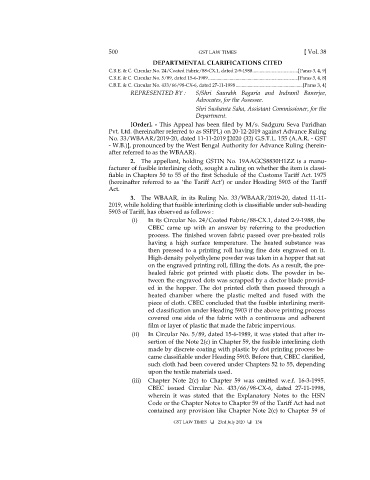
500 GST LAW TIMES [ Vol. 38
DEPARTMENTAL CLARIFICATIONS CITED
C.B.E. & C. Circular No. 24/Coated Fabric/88-CX.1, dated 2-9-1988 ...................................... [Paras 3, 4, 9]
C.B.E. & C. Circular No. 5/89, dated 15-6-1989 ........................................................................... [Paras 3, 4, 8]
C.B.E. & C. Circular No. 433/66/98-CX-6, dated 27-11-1998 ........................................................ [Paras 3, 4]
REPRESENTED BY : S/Shri Saurabh Bagaria and Indranil Banerjee,
Advocates, for the Assessee.
Shri Sushanta Saha, Assistant Commissioner, for the
Department.
[Order]. - This Appeal has been filed by M/s. Sadguru Seva Paridhan
Pvt. Ltd. (hereinafter referred to as SSPPL) on 20-12-2019 against Advance Ruling
No. 33/WBAAR/2019-20, dated 11-11-2019 [2020 (32) G.S.T.L. 155 (A.A.R. - GST
- W.B.)], pronounced by the West Bengal Authority for Advance Ruling (herein-
after referred to as the WBAAR).
2. The appellant, holding GSTIN No. 19AAGCS8830H1ZZ is a manu-
facturer of fusible interlining cloth, sought a ruling on whether the item is classi-
fiable in Chapters 50 to 55 of the first Schedule of the Customs Tariff Act. 1975
(hereinafter referred to as ‘the Tariff Act’) or under Heading 5903 of the Tariff
Act.
3. The WBAAR, in its Ruling No. 33/WBAAR/2019-20, dated 11-11-
2019, while holding that fusible interlining cloth is classifiable under sub-heading
5903 of Tariff, has observed as follows :
(i) In its Circular No. 24/Coated Fabric/88-CX.1, dated 2-9-1988, the
CBEC came up with an answer by referring to the production
process. The finished woven fabric passed over pre-heated rolls
having a high surface temperature. The heated substance was
then pressed to a printing roll having fine dots engraved on it.
High-density polyethylene powder was taken in a hopper that sat
on the engraved printing roll, filling the dots. As a result, the pre-
healed fabric got printed with plastic dots. The powder in be-
tween the engraved dots was scrapped by a doctor blade provid-
ed in the hopper. The dot printed cloth then passed through a
heated chamber where the plastic melted and fused with the
piece of cloth. CBEC concluded that the fusible interlining merit-
ed classification under Heading 5903 if the above printing process
covered one side of the fabric with a continuous and adherent
film or layer of plastic that made the fabric impervious.
(ii) In Circular No. 5/89, dated 15-6-1989, it was stated that after in-
sertion of the Note 2(c) in Chapter 59, the fusible interlining cloth
made by discrete coating with plastic by dot printing process be-
came classifiable under Heading 5903. Before that, CBEC clarified,
such cloth had been covered under Chapters 52 to 55, depending
upon the textile materials used.
(iii) Chapter Note 2(c) to Chapter 59 was omitted w.e.f. 16-3-1995.
CBEC issued Circular No. 433/66/98-CX-6, dated 27-11-1998,
wherein it was stated that the Explanatory Notes to the HSN
Code or the Chapter Notes to Chapter 59 of the Tariff Act had not
contained any provision like Chapter Note 2(c) to Chapter 59 of
GST LAW TIMES 23rd July 2020 134

